

QQQ has rallied into the R2 resistance (725.50ish/top of ‘optimal’ shoring zone) on my 5-minute chart, offering an objective short entry as would any additional push into, but not above the R3 zone/”still objective shorting zone”. Previous (yesterday) & updated 5-minute charts below.
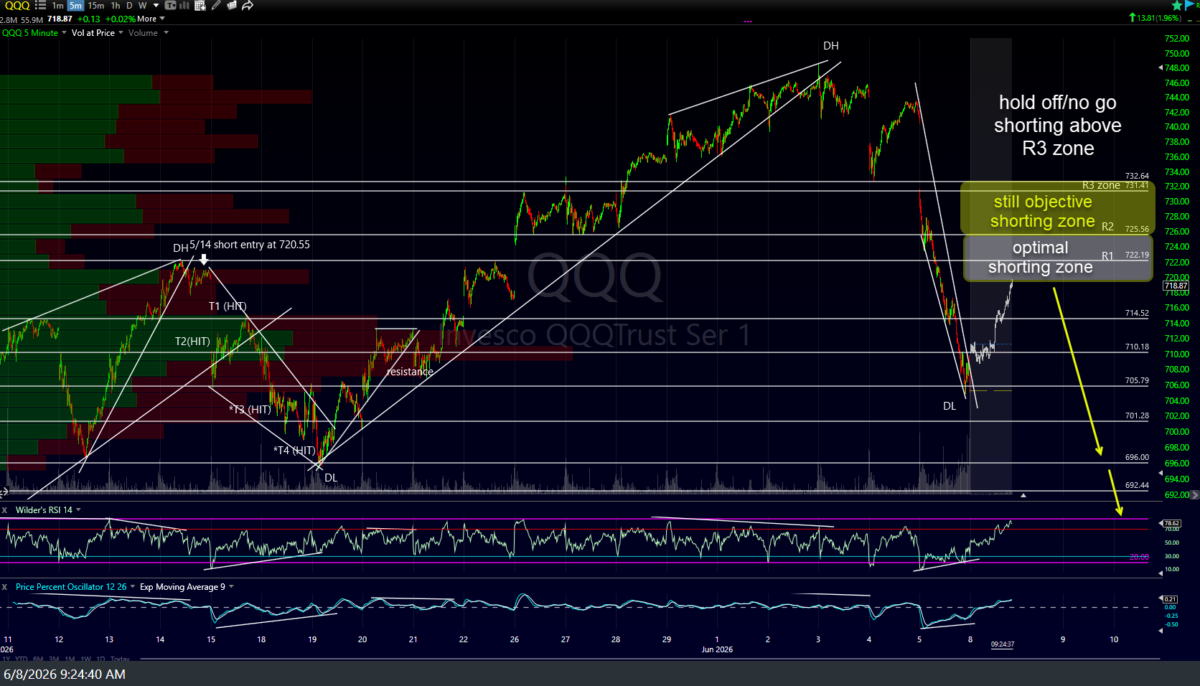
QQQ 5m June 8th
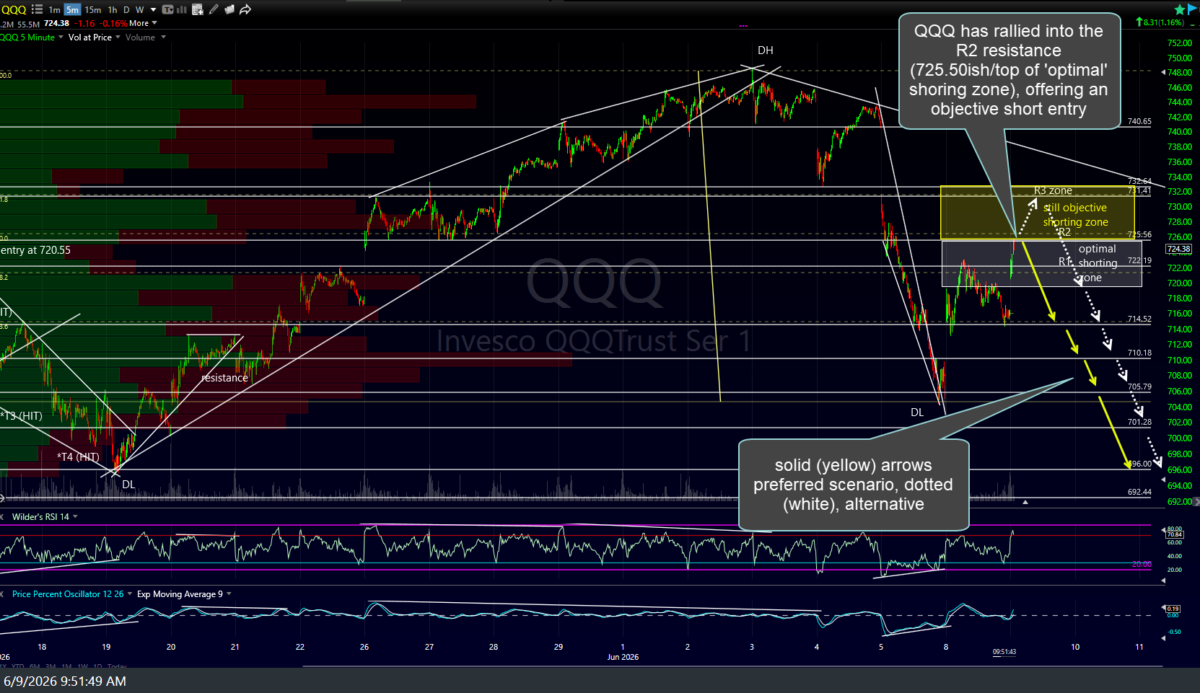
QQQ 5m June 9th
Zooming out to the more significant daily time frames, all of the major stock indices, including “THE” stock market*, VTI, have formed potential** bear flag continuation patterns. Daily charts of VTI, SPY, & QQQ, including the measured targets, assuming that A) the bear flags do end up keeping their current symmetry, B) do go on to trigger a sell signal soon, and C) reversing here at the highlighted resistance or not much higher, as the measured target is the distance of the flagpole, added to the highest point of the flag before it breaks down.
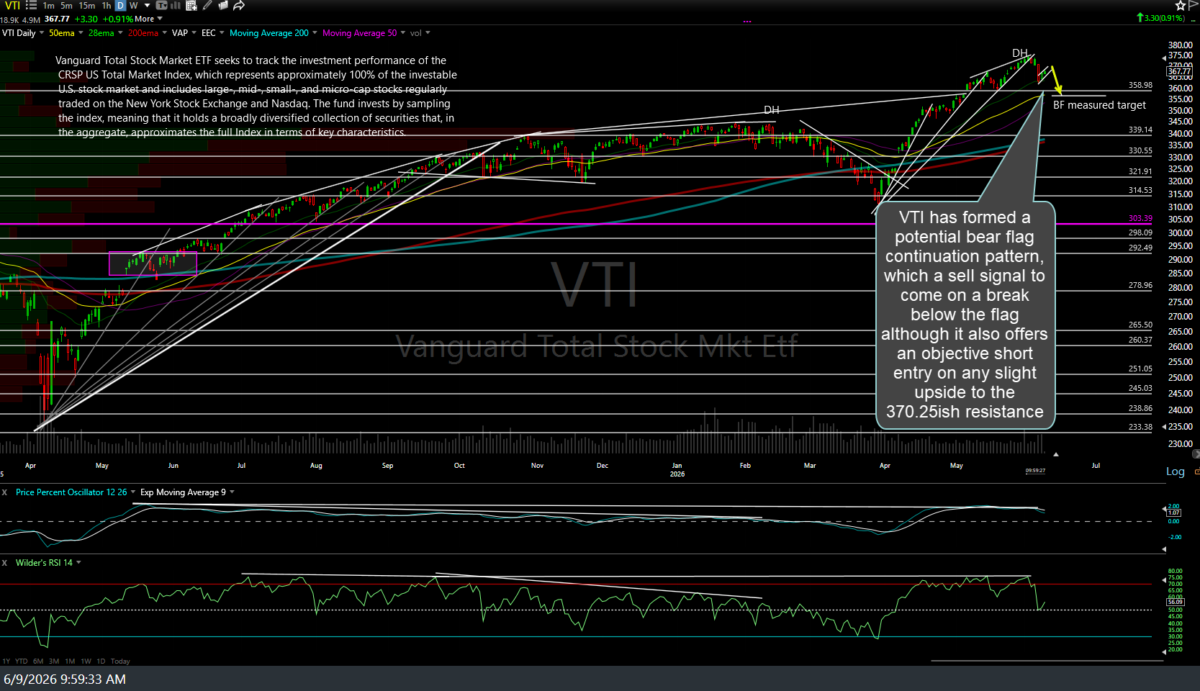
VTI daily June 9th
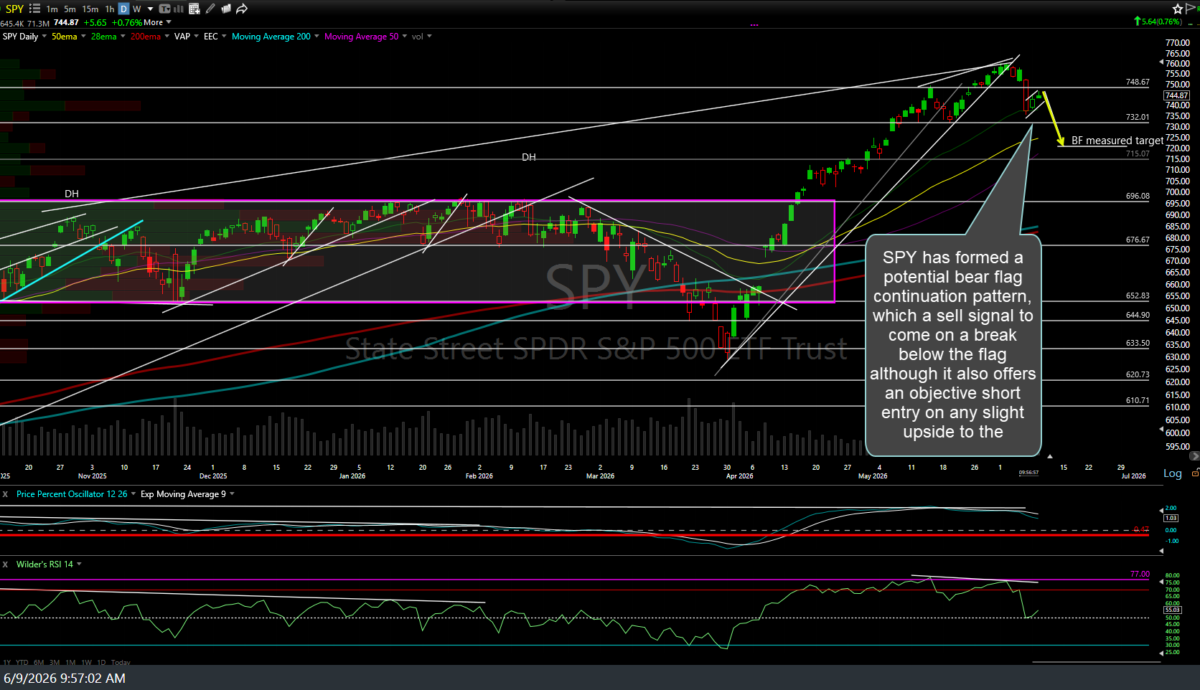
SPY daily June 9th
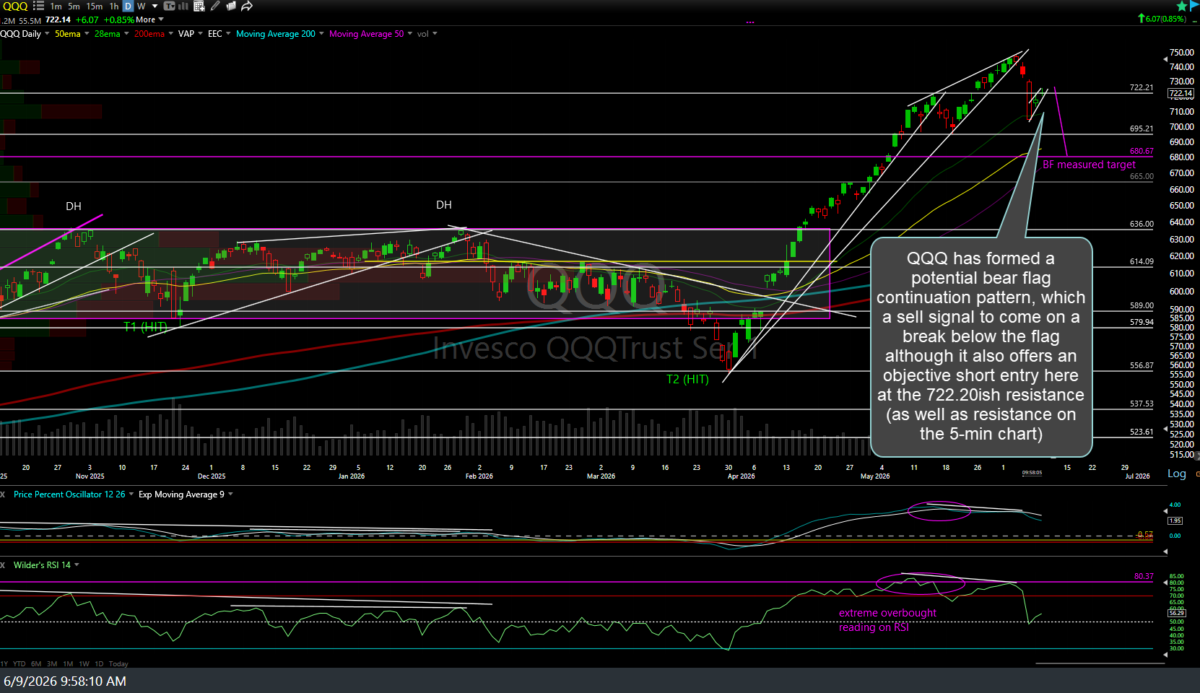
QQQ daily June 9th
*Vanguard Total Stock Market ETF seeks to track the investment performance of the CRSP US Total Market Index, which represents approximately 100% of the investable U.S. stock market and includes large-, mid-, small-, and micro-cap stocks regularly traded on the New York Stock Exchange and Nasdaq. The fund invests by sampling the index, meaning that it holds a broadly diversified collection of securities that, in the aggregate, approximates the full Index in terms of key characteristics.
**A potential bearish chart pattern is just that: a potential setup requiring a sell signal/entry trigger. In this case, that would be a solid breakdown below the bear flag continuation pattern (lower uptrend line).
I also wanted to share my reply to a question put to me in a couple of the recent comment sections under the home page posts:
Q: How is SpaceX[sic] going to effect our now short position? Thx
My reply: Short answer: I have no idea. It all depends on how it performs 15 days post-IPO (that’s when it will start inclusion in the Q’s), although from what I understand, it will only have about a 0.47%-0.70% weighting in the Nasdaq 100 & no weighting (not included) in the S&P 500, so really, not much other than maybe a psychological impact to some degree should it plunge or rip, post-IPO.
Additional info on SpaceX via Perplexity (I cannot guarantee, nor have I vetted the following for accuracy. As such, one might want to verify via other sources):
Planned Index Inclusions and Expected Weightings [8]
| Index [1, 2, 4, 5, 7, 8, 9] | Expected Inclusion Timeline | Projected Index Weighting | Primary Tracking Funds Impacted |
|---|---|---|---|
| Nasdaq-100 | 15 trading days post-IPO | 0.47% to 0.70% (Under 1% total) | Invesco QQQ Trust (QQQ), QQQM |
| CRSP Large Cap Growth | 5 trading days post-IPO | 0.17% to 0.26% | Vanguard Growth ETF (VUG) |
| CRSP Total Market Index | 5 trading days post-IPO | 0.07% to 0.11% (Under 0.20%) | Vanguard Total Stock Market (VTI) |
| Russell 1000 | 5 trading days post-IPO | ~0.15% to 0.22% (Estimated) | iShares Russell 1000 ETF (IWB) |
| S&P 500 | Excluded indefinitely | 0.00% | SPDR S&P 500 ETF Trust (SPY) |
Crucial Mechanics Behind the Weightings
1. The Nasdaq-100 “Float-Multiplier” Rule Boosts Weighting [10]
2. Total Market vs. Free-Float Discrepancy
3. Why the S&P 500 Rejected Fast-Tracking
- The Profitability Rule: Companies must post four consecutive quarters of cumulative positive GAAP earnings. SpaceX’s ongoing capital spend on Starlink and Starship means it operates at a net GAAP loss.
- Seasoning Requirement: A newly public company must trade on an exchange for at least 12 months before consideration. [4, 13, 14, 15, 16]